Traffic–Vehicle Co-Simulation Framework
This document provides an overview of the co-simulation framework used in this project, which integrates:
SUMO traffic simulation
Traffic layer (C++ / FIXS)
Python controller
Simulink high-fidelity vehicle dynamics model
The figures below illustrate the system architecture and the message flow between different components under several modeling assumptions.
1. Co-Simulation Model Overview
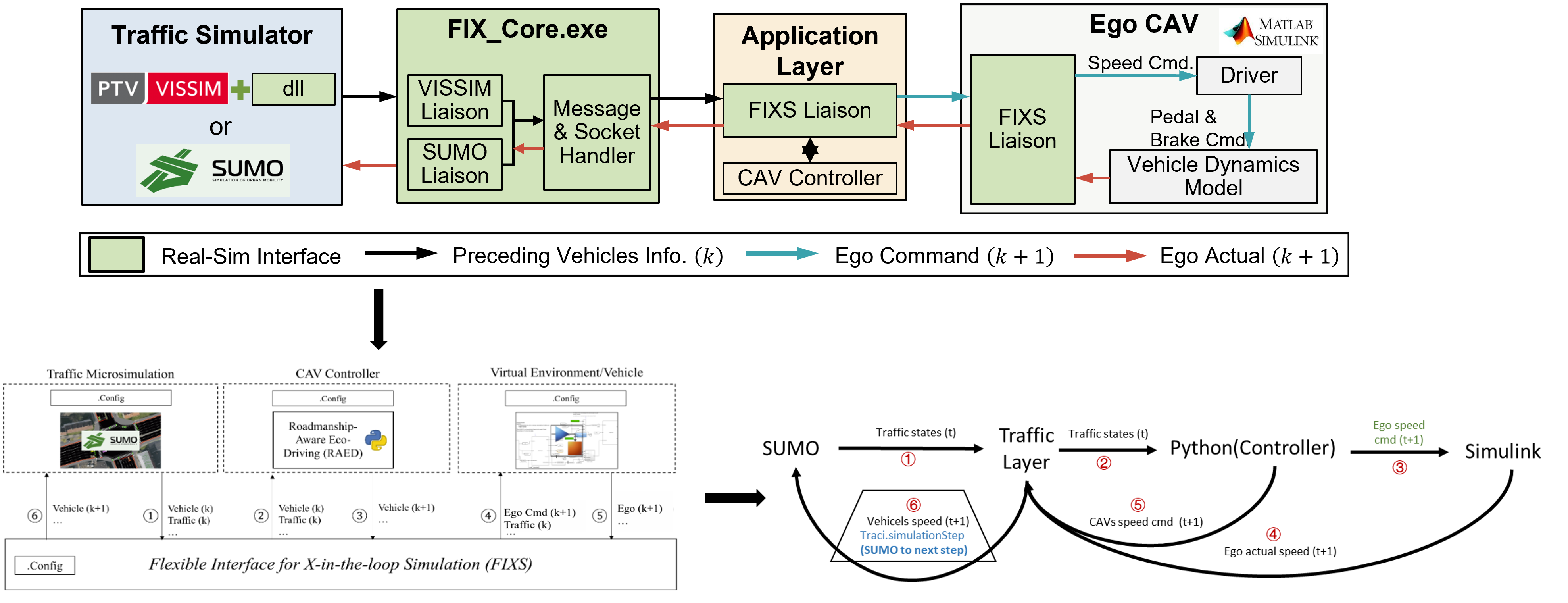
The following figure shows the overall structure of the co-simulation framework used in this project.
It illustrates how the traffic simulation layer, control layer, and high-fidelity vehicle model interact with each other.
2. Final model message Flow
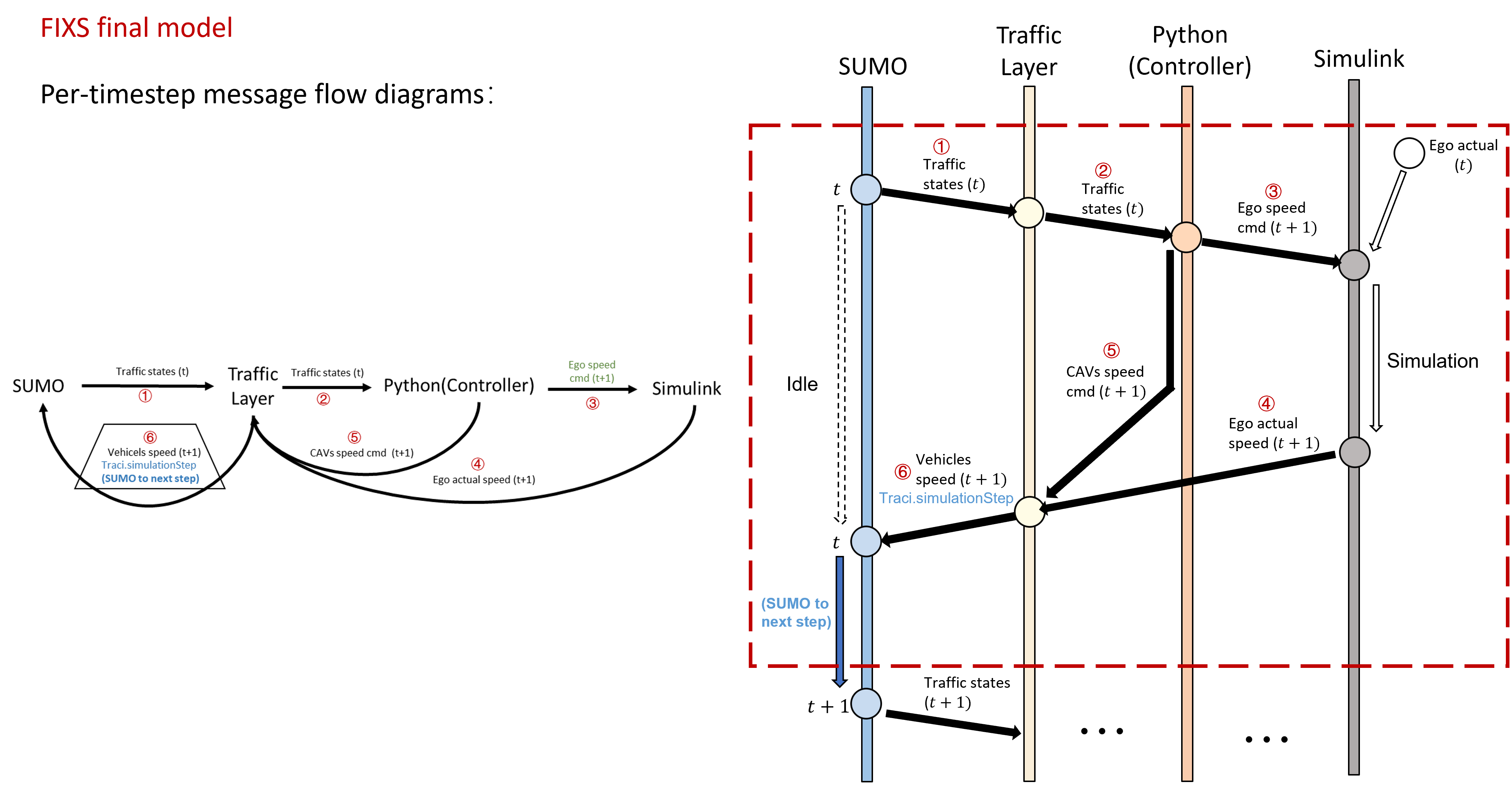
This figure illustrates the Final and ideal message flow for the co-simulation framework.
In this architecture:
The traffic simulator provides vehicle states.
The controller computes control commands.
The high-fidelity vehicle model generates physically consistent vehicle responses.
The resulting states are fed back into the traffic simulator.
This design represents the target architecture for fully consistent traffic–vehicle co-simulation.
3. Current Implementation
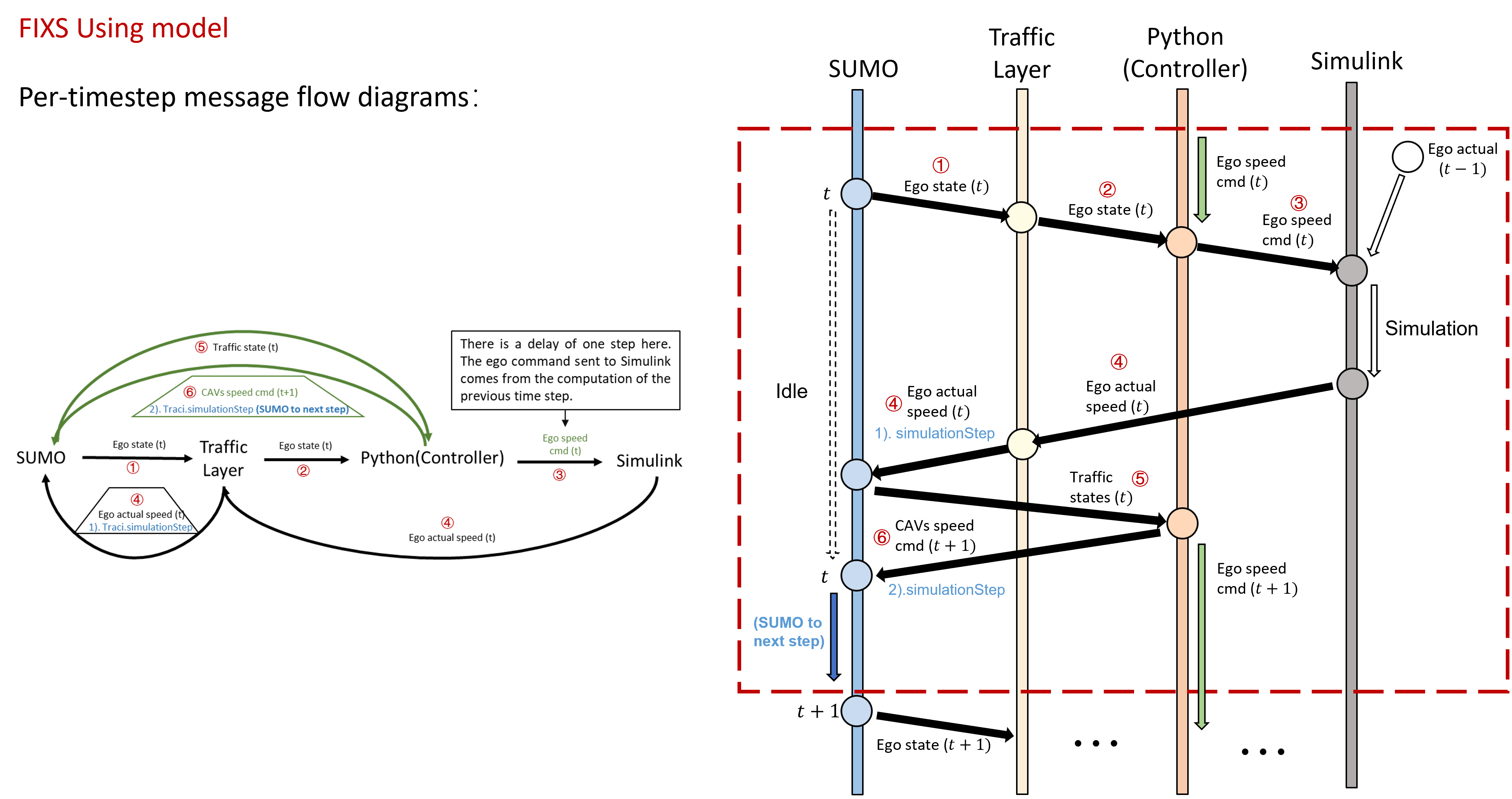
The following diagram shows the current implementation used in the project.
Compared to the ideal framework, some components or data pathways may be different due to implementation constraints.
This figure highlights how information currently flows between:
SUMO
Traffic Layer
Python controller
Simulink vehicle model
In the current architecture, the speed command applied to the ego vehicle has a one-step delay due to the message exchange sequence. The main reason is that SUMO has two clients: Python and Traffic Layer. For implementation details, please refer to the Python control code.
4. Baseline Model
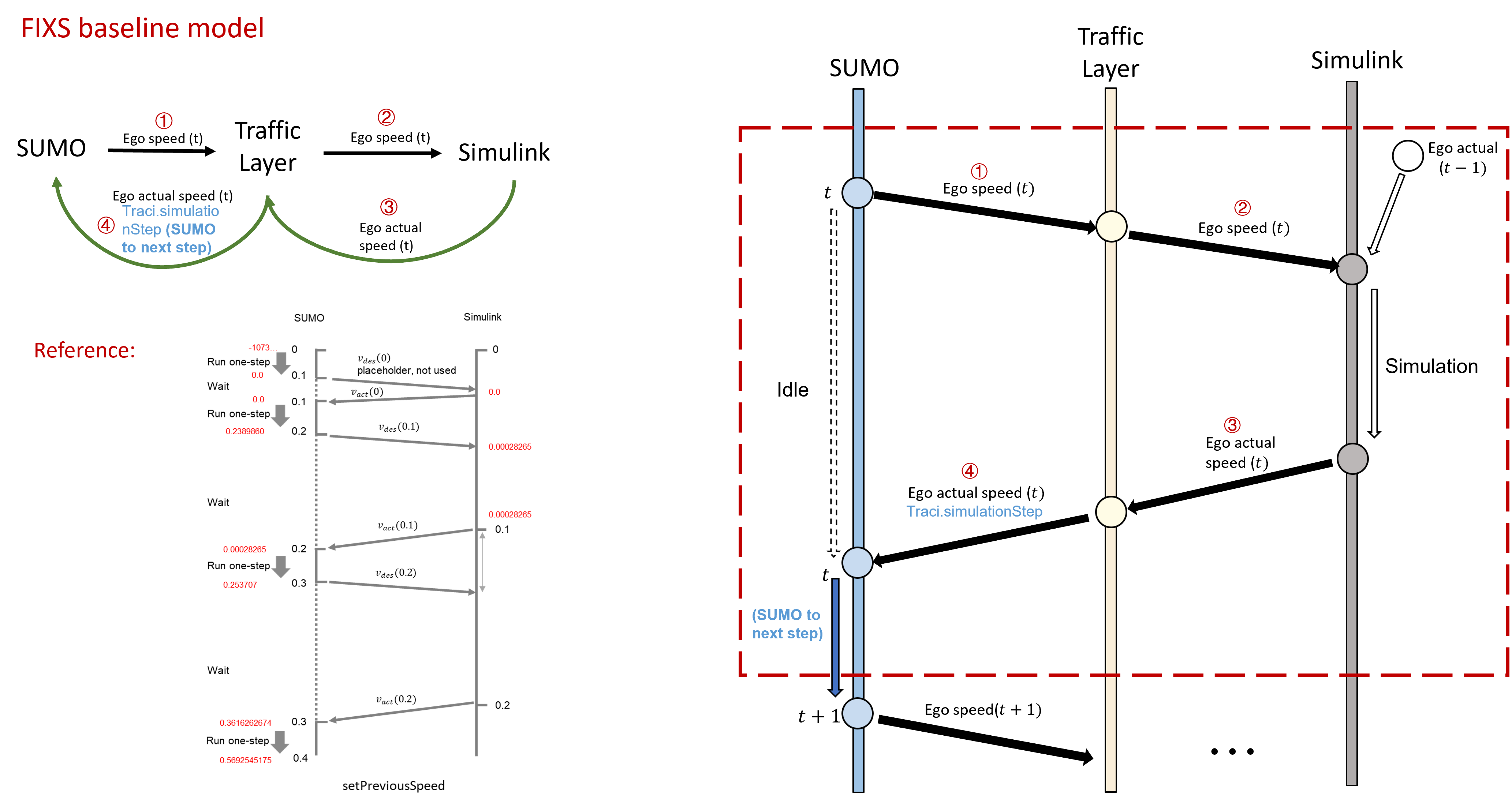
The baseline model represents a simplified configuration used for comparison with the proposed co-simulation framework.
In this setup, the ego vehicle does not obtain a speed command from the controller.
Instead, vehicle states from the traffic simulator are directly passed to the high-fidelity vehicle dynamics model, which computes the vehicle response and returns the resulting states to the traffic simulatior.
This configuration is used as a reference case for evaluating the impact of the controller and the co-simulation framework.
Notes
This document provides a high-level overview of the simulation architecture.
More detailed explanations of each component and interface will be added in future updates.